Start from the electrical length
Use the calculated radiator length as a starting point for the target band, then tune the completed antenna at its installed height.
Popular mobile and base vertical with lower takeoff angle and ~3 dB gain over a ¼-wave.
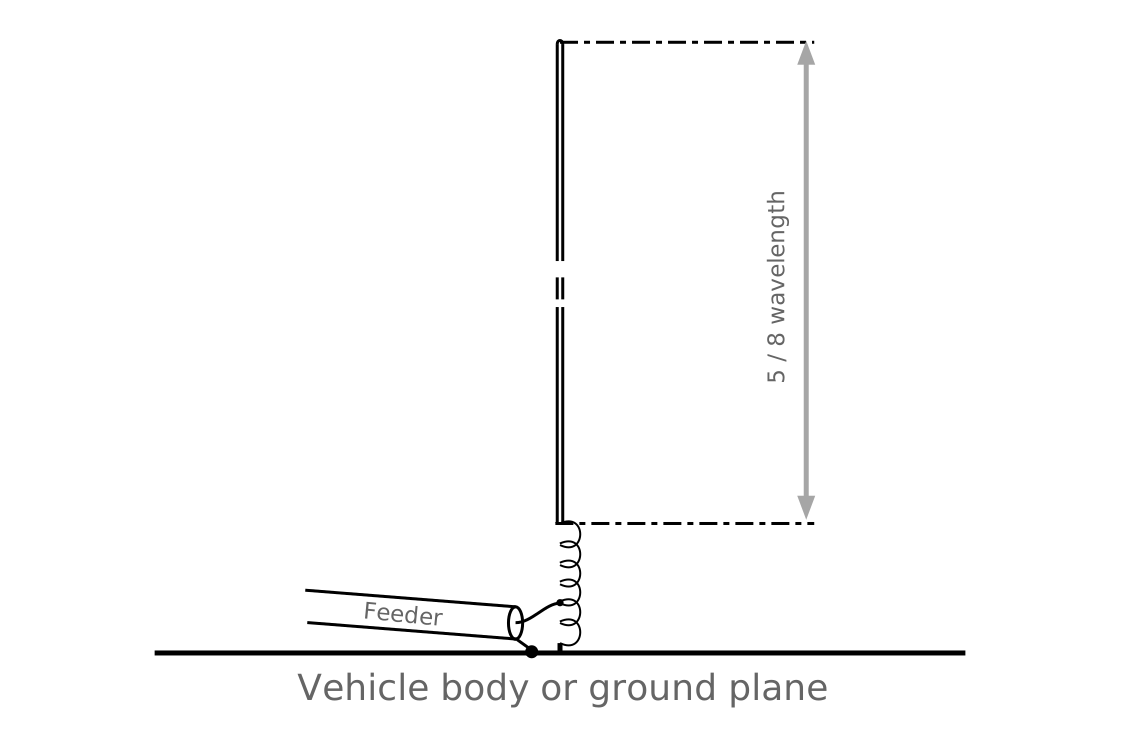
The five-eighths-wave vertical is an extended vertical radiator intended to concentrate more energy at useful low elevation angles than a simple quarter-wave in suitable installations. The illustration on this page is therefore conceptual rather than a promise that every five-eighths-wave antenna will produce a fixed gain. The actual pattern depends on the ground or radial system, conductor dimensions, loading arrangement, mounting structure and nearby objects.
The calculator starts from the five-eighths-wavelength relationship and gives a physical length suitable as a first design value. A practical 5/8-wave vertical often uses a matching or loading section because the desired radiation length and the feedpoint impedance are not the same problem. The electrical length can also be altered by a base coil, top loading, capacitance and the surrounding structure. This is why a dimension calculated from free space should not be treated as a finished construction drawing.
The design is particularly common at VHF and UHF where a five-eighths radiator remains mechanically manageable and a low-angle pattern can be useful for terrestrial coverage. Mobile installations add the vehicle body as part of the RF counterpoise or ground reference, so changing the mounting location can change the match. For a fixed station, the radial arrangement and their height above ground can have a strong effect. Build the radiator slightly long, establish the intended mounting and ground configuration, then measure at low power. Adjust the physical radiator or matching section in small steps and record the final dimensions. The image helps distinguish the five-eighths concept from a generic quarter-wave whip: the extra electrical length is part of the design goal, not merely a decorative extension.
Provides a lower radiation angle than a ¼-wave, useful for DX on VHF. Base loading or matching network is almost always needed.
Use the calculated radiator length as a starting point for the target band, then tune the completed antenna at its installed height.
A 5/8-wave vertical is sensitive to the matching network, radial system, conductor diameter and installation height. The radiator alone does not define the feedpoint match.
Measure both resonance and feedpoint impedance. If the antenna is not close to the intended match, inspect the matching section before cutting large amounts of wire.